
Virtual Lactation Consultant vs. In-Person: Which Is Right for You?
For most breastfeeding concerns, a virtual IBCLC consultation is just as effective as an in-person visit, and often more practical. Research published in JAMA Network Open (2025) found that telelactation services improved breastfeeding outcomes, with 71% of mothers still breastfeeding at six months compared to 67% in the control group. A systematic review and meta-analysis in BMC Pregnancy and Childbirth (2025) confirmed that real-time telelactation had a statistically significant positive effect on exclusive breastfeeding rates.
At LatchLine, virtual lactation consultations are what we do best, and the evidence backs up what our families already know: expert IBCLC support works beautifully through a screen.
But virtual isn't the right fit for every single situation. This guide from LatchLine breaks down exactly what each option offers, when virtual shines, when in-person may be better, and how to decide what's right for your family.

Getting breastfeeding help doesn’t have to be complicated!
What Happens During a Virtual Lactation Consultation?
A virtual lactation consultation is a one-on-one video appointment with a board-certified IBCLC from the comfort of your home. Here's what a typical LatchLine virtual visit looks like:
Health history review: Your IBCLC gathers information about your pregnancy, birth experience, baby's feeding patterns, and any concerns
Live feeding observation: You'll nurse or bottle-feed your baby on camera while your consultant observes latch, positioning, baby's sucking patterns, and swallowing
Real-time coaching: Your IBCLC guides you through adjustments to positioning, latch, and technique while you practice together
Assessment and education: Discussion of what's going on, why it's happening, and what to do about it
Personalized care plan: A written summary of recommendations, next steps, and when to follow up
Follow-up support: At LatchLine, you also get secure messaging access for questions that pop up between visits
The whole process typically takes 60-90 minutes, and you never have to leave your couch.
What Happens During an In-Person Lactation Consultation?
An in-person consultation follows a similar flow, but with some additional physical components:
Hands-on assessment: Your IBCLC can physically examine your baby's mouth (checking for tongue ties, palate shape, jaw tension) and your breast tissue
Weighted feeds: Using a clinical-grade scale, the consultant weighs your baby before and after a feeding to measure exactly how much milk transferred
Physical positioning assistance: Your consultant can use their hands to help guide baby to latch and adjust your hold in real time
Equipment check: Hands-on evaluation of your breast pump, flanges, and any supplemental feeding devices
In-person visits typically happen in a clinic, hospital, or the consultant's office, and sometimes through home visits, though availability varies by area.
How Do Virtual and In-Person Consultations Compare?
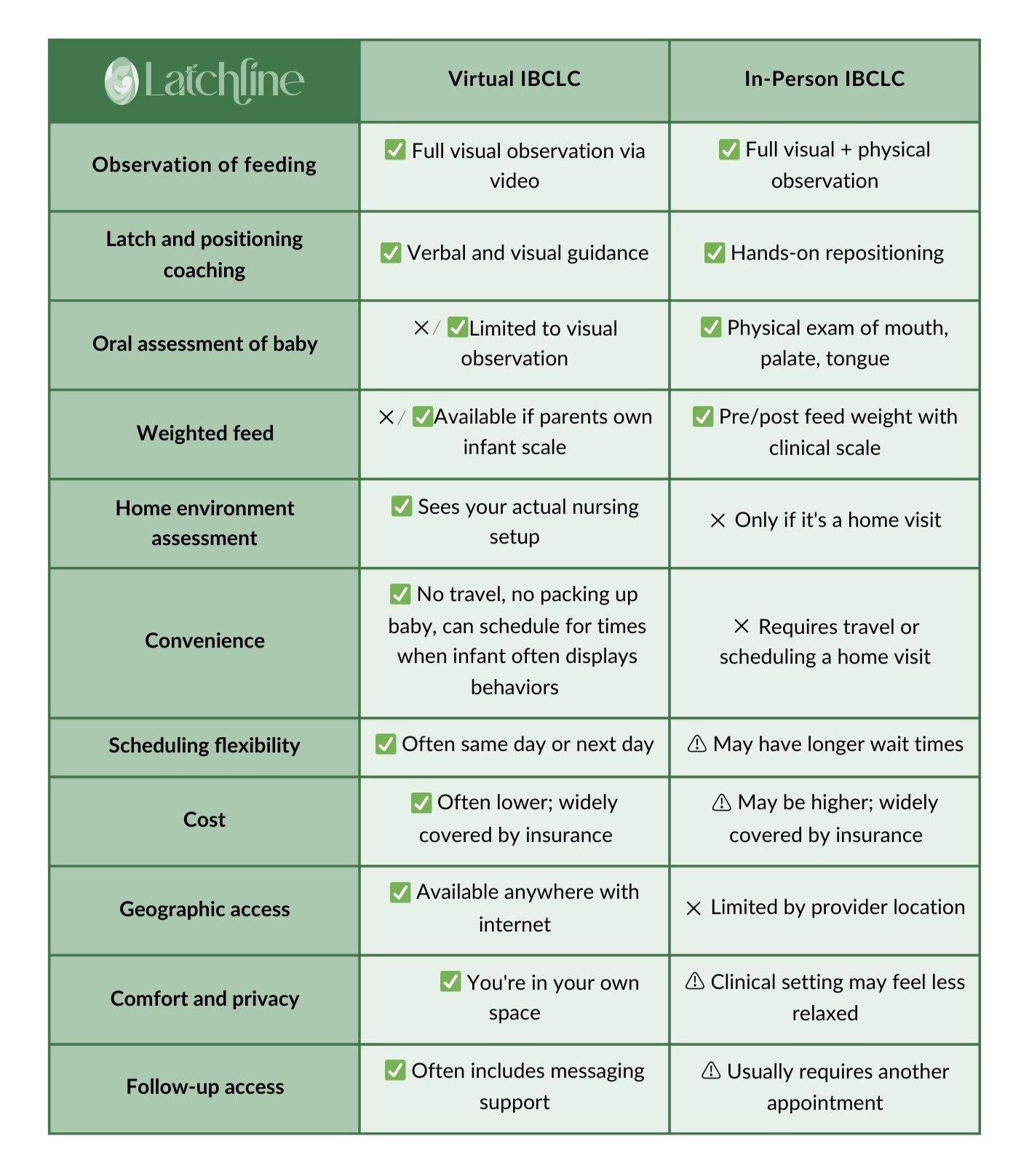
How Do Virtual and In-Person Consultations Compare?
When Virtual Is the Better Choice
For the majority of breastfeeding concerns, virtual consultations are not just "good enough", they're often the better option. Here's when virtual shines:
You want coaching in your real feeding environment
One of the biggest advantages of virtual is that your IBCLC sees exactly where and how you feed your baby every day. That deep couch with no arm support? The way you prop pillows? The lighting in your nursery at 2 AM? Your consultant can give advice that's tailored to your actual life, not a clinical exam room you'll never sit in again.
You have a newborn and leaving the house feels impossible
Getting out the door with a days-old baby, timing it between feeds, packing the diaper bag, wrestling a car seat… it’s exhausting. Virtual eliminates all of that. You can consult with an expert IBCLC while your baby naps on your chest.
You're dealing with common breastfeeding challenges
Latch difficulties, nipple pain, positioning issues, low supply concerns, pumping questions, return-to-work planning, engorgement, bottle refusal, weaning: these are all concerns that a skilled virtual IBCLC can assess and address effectively through video.
You're a military family stationed overseas
If you're stationed in Europe through the military, your in-person IBCLC options may be limited, especially English-speaking providers who understand American insurance. LatchLine was specifically built for this: virtual IBCLC care covered by TRICARE Overseas.
You need flexible scheduling
Virtual providers often have more scheduling availability and can accommodate nap schedules, work schedules, and time zone differences more easily than brick-and-mortar clinics.
You want continuity of care
With virtual, you can see the same IBCLC for every visit regardless of where you are; whether you've moved, are traveling, or just prefer consistency.
When In-Person May Be the Better Choice
There are specific clinical situations where hands-on assessment provides information that video can't fully replicate:
Suspected tongue tie or oral restriction
If there's concern about a tongue tie, lip tie, or other oral restriction affecting your baby's ability to latch and transfer milk, an in-person IBCLC can perform a thorough physical examination of your baby's mouth, feeling the tongue's range of motion, checking the palate, and assessing jaw function. A virtual consultant can observe feeding and identify red flags as well as help with latching after a revision, but the definitive physical assessment typically needs to happen in person.
You need a weighted feed
If there's concern about how much milk your baby is actually transferring during a feeding, a weighted feed (pre- and post-feed weight on a clinical-grade scale) is the gold standard for measurement. This can only be done in person. Your virtual IBCLC may recommend this as a next step if transfer concerns arise during your virtual visit and you don’t have an infant scale at home.
Complex medical situations
Some situations, like babies with cleft palate, significant prematurity, neurological conditions, or cardiac issues, may benefit from the additional information a hands-on assessment provides, especially in the early days. However, many families with complex situations use a combination of in-person and virtual care.
You've tried virtual and want hands-on help
Sometimes, despite great verbal and visual coaching, you want someone to physically guide your hands, reposition your baby, or demonstrate a technique in person. That's completely valid. Not every learner absorbs information the same way.
The Best Approach? Start Virtual, Add In-Person If Needed
Here's what LatchLine recommends: start with a virtual consultation. The vast majority of breastfeeding concerns can be fully addressed virtually, and you'll get expert guidance faster, more conveniently, and often at lower cost.
If your virtual IBCLC identifies something that needs hands-on assessment (like a suspected tongue tie or a need for a weighted feed) they'll tell you, and can help you find a trusted in-person provider near you for that specific evaluation. Many families find that a single virtual visit resolves their concerns entirely. Others use an ongoing combination of virtual check-ins with occasional in-person visits, getting the best of both worlds.
At LatchLine, Abigail Miles, RN, IBCLC provides comprehensive virtual lactation consultations for families in Indiana, nationwide through Cigna and HSA/FSA, and overseas through TRICARE. Whether breastfeeding is going smoothly and you just want reassurance, or you're struggling and need expert help now, virtual IBCLC support can meet you exactly where you are. Literally.
Frequently Asked Questions
Is a virtual lactation consultant as effective as in-person?
Yes! Research shows virtual lactation consultations are just as effective as in-person visits for most breastfeeding concerns. A 2025 study in JAMA Network Open found that mothers with telelactation access had higher breastfeeding rates at six months. Virtual allows your IBCLC to observe feeding in your real home environment, which can lead to more personalized guidance.
What breastfeeding issues can be addressed virtually?
Most common concerns can be fully addressed through a virtual IBCLC consultation, including: latch difficulties, nipple pain, positioning, low or oversupply, engorgement, pumping support, return-to-work planning, bottle refusal, weaning, combo feeding, and more. LatchLine addresses all of these through virtual video consultations.
When should I see a lactation consultant in person instead?
In-person visits are most valuable when a physical oral assessment is needed (suspected tongue tie), when a weighted feed is required to measure milk transfer, or for complex medical situations. Your virtual IBCLC at LatchLine will always recommend in-person evaluation if clinically indicated.
Does insurance cover virtual lactation consultations?
Yes! Under the Affordable Care Act, most insurance plans cover lactation support, including virtual visits, at no cost. LatchLine accepts Cigna (nationwide), Aetna (Indiana), UnitedHealthcare (Indiana), TRICARE Overseas, and HSA/FSA.
Can military families get virtual IBCLC support overseas?
Absolutely. LatchLine specifically serves military families stationed in Europe through TRICARE Overseas coverage. Virtual consultations work across time zones, so you get expert IBCLC care no matter where you're stationed.
How do I book a virtual consultation with LatchLine?
Visit mylatchline.com to check your insurance coverage and book a virtual IBCLC consultation with Abigail Miles, RN, IBCLC. Most families can be seen quickly, because breastfeeding challenges don't wait, and neither should your support.